
Understanding Black Holes: A Simple Explanation
Black holes are some of the most mysterious objects in the universe. This article aims to explain these enigmatic phenomena in an accessible manner, covering the following topics:
- Newton’s law of universal gravitation
- The Schwarzschild radius
- The birth and death of stars
- How black holes form in the universe
Newton’s Law of Universal Gravitation
Long before Einstein’s theory of relativity provided an in-depth explanation of gravitation and black holes, scientists during Isaac Newton’s era were intrigued by the concept of a place where escape velocity exceeded the speed of light. Such a place, where even light cannot escape, was later termed a black hole.
To understand this curiosity, we must first explore Newton’s law of universal gravitation. This law states that every object in the universe attracts every other object. The force of attraction is directly proportional to the product of their masses and inversely proportional to the square of the distance between them.
At that time, the nature of light was a topic of active debate. Christiaan Huygens proposed the wave theory of light, while Newton and others supported the corpuscular theory, viewing light as particles. The dual nature of light, which combines both particle and wave aspects, was later confirmed. However, thinkers of that era believed that if light behaved as particles, it should be influenced by gravity.
A thought experiment from that period suggested that a celestial body with an escape velocity greater than the speed of light would attract light, rendering it invisible to the naked eye and detectable only through its gravitational effects on nearby objects.
The Schwarzschild Radius
The escape velocity equation is crucial in understanding black holes. It is given by:
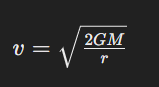
where ( v ) is the escape velocity, ( M ) is the mass of the celestial object, and ( r ) is its radius.
The Schwarzschild radius (( r )) defines the event horizon of a black hole. If an object with mass ( M ) is compressed into a radius ( r ), it will behave like a black hole, with even light unable to escape.
The universal gravitational constant (( G )) is ( 6.67430 X10⁻¹¹ \, m^3 kg-1 s-2), and the speed of light (( C )) is approximately ( 3x 10⁸ m/s ).
To calculate the Schwarzschild radius for Earth, we find it would be approximately 8.8 mm if it were to become a black hole.
Birth and Death of a Star
Stars are born in gas clouds called nebulas, where atoms are drawn together by gravity. As mass increases, so does the gravitational pull. When nuclear fusion begins in these gas spheres, the outward pressure from fusion balances the inward pull of gravity, achieving hydrostatic equilibrium, marking the birth of a star.
After billions of years, when hydrogen is fused into helium and fusion ceases, gravity dominates, causing the star to collapse into a compact object. The star’s fate depends on its mass:
- Stars with masses less than 1.4 times that of the Sun (Chandrasekhar Limit) become white dwarfs.
- Stars with masses exceeding this limit become neutron stars.
- Stars with masses greater than three times that of the Sun become black holes.
A comprehensive explanation of black holes also involves Einstein’s General Theory of Relativity and Stephen Hawking’s theories, which will be discussed in another article.



 the sky codex
Leave a comment